Crimestoppers
 Fearless - our youth service
No reason for abuse in Hampshire
Crimestoppers launches 12 month campaign in Hampshire to help put a stop to domestic abuse.
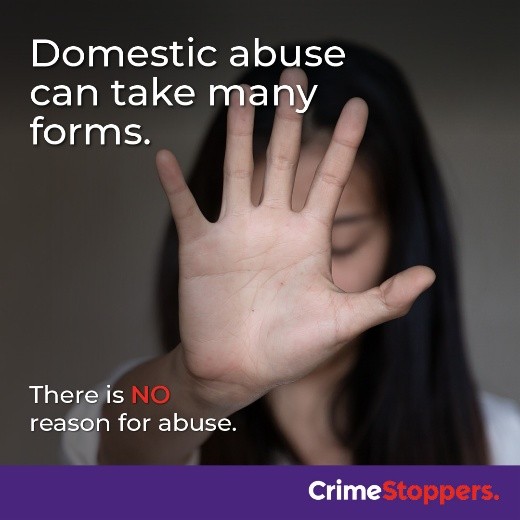
It's estimated that more than 50,000 people were subjected to domestic abuse In Hampshire during 2022-2023 and that more than 40,000 children were exposed, in their own home, to domestic abuse between adults.
To make matters worse, domestic abuse has a higher rate of repeat offenders than any other crime - in Hampshire, almost a third of those carrying out abusive behaviours were involved in more than one domestic abuse incident.
It's also a crime where the individual subjected to abuse can find it extremely difficult to speak up. It’s hard for friends and family members to know what to do – they may want to contact the police but they worry that the perpetrator will find out, leading to more abuse against the person they most want to protect.
Our 'no reason for abuse' campaign seeks to empower people by letting them know that they can speak up with information, 100% anonymously - guaranteed.
When you contact Crimestoppers, your call, device and location cannot be traced and you will never be asked for your name. There’s no police involvement, no witness statement to make and you won’t attend court to give evidence.
No one will know that you spoke up – ever.
Call free, any time, on 0800 555 111 or fill in our secure online form, here on our website:
Not all abuse is physical and this campaign highlights the different forms of domestic abuse and the signs to look out for that it may be happening to someone you know. It also outlines typical behaviours of an abuser, and focuses on the effects on those who witness domestic abuse, particularly young children. Find out more below.
Domestic abuse is behaviour from a family member, partner or ex-partner that is controlling, coercive, threatening, violent or abusive, and happens between people aged over 16. It can happen to men or women.
It includes the following types of abuse:
- Psychological
- Physical
- Sexual
- Financial or economic; find out more about this here
- Emotional
The evidence that domestic abuse is taking place can be hard to spot. Some of the following are signs to watch out for:
- Their partner puts them down in front of other people
- They are constantly worried about making their partner angry
- They make excuses for their partner’s behaviour
- Their partner is extremely jealous or possessive
- They have unexplained marks or injuries
- They’ve stopped spending time with friends and family
- They are depressed or anxious, or you notice changes in their personality
You may be a neighbour who sees or hears the following:
- Threatening and intimidating arguments, which may involve violent language or escalate to smashing up the furniture
- Arguments where the partner blames the other for their actions, saying they are “asking for it” or deserve the abuse
- Individuals with bruising or other visible marks, which may have been caused by physical abuse
Any adult, no matter what their gender or sexual orientation, can be a perpetrator of abuse. They display behaviours such as:
- They are jealous and possessive
- They control money, food, clothes and other aspects of their partner’s life
- They may blame alcohol, drugs or their mental health for the way they behave
- They behave differently in front of others, showing everyone else a kind, caring and fun front
If you think your own behaviour is crossing the line into abuse, call the Respect Phoneline on 0808 802 4040 to get the help you need.
Being exposed to domestic abuse in childhood is child abuse. The NSPCC explains how domestic abuse always has an impact on children.
They may experience:
- Not getting the care and support they need from their parents or carers as a result of the abuse
- Hearing the abuse from another room
- Seeing someone they care about being injured and/or distressed
- Finding damage to their home environment like broken furniture
- Being hurt from being caught up in or trying to stop the abuse
- Being denied access to parts of their home, such as rooms being locked
- Being forced out of or losing their home
This can lead to:
- aggression and challenging behaviour
- depression and anxiety
- changes in mood
- difficulty interacting with others
- withdrawal
- fearfulness, including fear of conflict
- suicidal thoughts or feelings
What you can do
If you are worried about someone experiencing domestic abuse, or if you know someone is an abuser, you can give your information to us here at Crimestoppers, 100% anonymously.
Call 0800 555 111 or fill in our quick and easy online form, here on our website:
In an emergency, always call 999.
In Hampshire (including Southampton and Portsmouth):
- Help, support and advice for victims of domestic abuse, friends and family:
Stop Domestic Abuse
Advice line: 0330 0533 630 or email advice@stopdomesticabuse.uk
https://stopdomesticabuse.uk/ - Help for perpetrators of domestic abuse:
The Hampton Trust
023 8000 1061 or info@hamptontrust.org.uk
https://hamptontrust.org.uk/
This campaign has been funded through the Police and Crime Commissioner for Hampshire and Isle of Wight’s Safer Communities Fund.

Find out more about domestic abuse on our keeping safe page